Mindset is Canada’s only journalist-to-journalist guide on mental health reporting, and includes information on reporting on suicide.
Language Matters: Safe Communication for Suicide Prevention
This booklet was created by the Public Health Agency of Canada in partnership with Centre for Suicide Prevention and l’Association québécoise de prévention du suicide, 2018.
Guidance on Trigger Warnings for Suicide and Emotionally Charged Content
International Association of Suicide Prevention, April 2026
Preventing suicide: a resource for media professionals, update 2023
The World Health Organization has released an updated suicide prevention guide for media professionals. Updates included in this resource focus on proactive reporting on stories of survival.
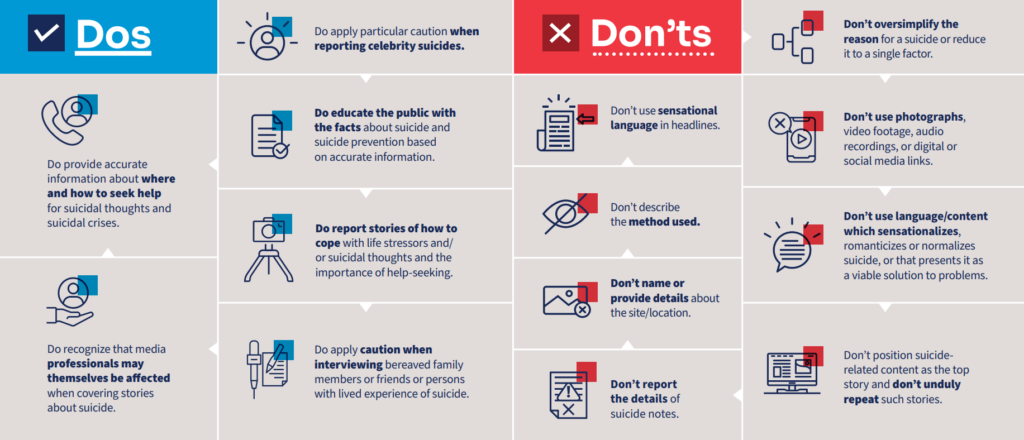
Media Guidelines on Reporting on Suicide
The Canadian Psychiatric Association released an update to their media guidelines for reporting on suicide in 2017.
Language Matters in Preventing Suicide
The Conversation – Authors: Neufeld, Karin, Chair of the Department of Psychiatry and Behavioural Neurosciences, McMaster University and Stacey, Sidney, Assistant Professor (PT) Department of Psychiatry & Behavioural Neurosciences, McMaster University & Chair Suicide Prevention Community Council of Hamilton, McMaster University, April 21, 2024